



Categories
Seller TipsPublished October 19, 2026
What Does It Actually Cost to Sell a Home in Texas?


Most Texas sellers walk away with roughly 7% to 10% less than their sale price once commissions, title, and closing items are paid. If you're retired and planning to downsize, that gap matters, because your net proceeds are what fund the next home, the move, and the cushion you want in the bank.
You spent decades in this house. Before you list it, it's worth knowing exactly where the money goes, which costs are fixed, and which ones you can negotiate. Here's the plain-English breakdown for North Texas sellers in 2026.

1. Agent commissions: the biggest line item
Commission is usually the largest single cost of selling, and in Texas the average total runs about 5.9% of the sale price (Real Estate Witch).
The rules changed in August 2024 with the National Association of Realtors settlement. Sellers are no longer required to offer a buyer's agent fee through the MLS, and buyers now sign their own agreement with their agent before touring homes (WealthVieu).
What that means for you:
- Listing agent fee — what you pay the agent who markets and sells your home. Negotiable.
- Buyer's agent fee — you may choose to offer it, or agree to cover it when a buyer asks. Many sellers still do, because it widens the pool of buyers.
- Everything is negotiable — there is no set rate in Texas. Ask any agent you interview to walk you through exactly what you'll pay and what you get for it.
2. Title insurance and closing fees
In Texas, the seller customarily pays for the buyer's owner's title insurance policy. It's a custom, not a law, so it can be negotiated (JVM Lending).
The good news: you can't overpay. The Texas Department of Insurance sets the premium, so every title company charges the same base rate. Those rates dropped 6.2% on March 1, 2026 (Neuhaus Realty). On a $400,000 sale, the owner's policy runs about $2,100 (Harbert Group).
Other closing-table items to expect:
- Escrow or settlement fee — often split with the buyer; a few hundred dollars each.
- Recording, courier, and document prep — small fees, usually under $300 combined.
- Survey — $400 to $600 if you agree to provide a new one. An existing survey with a T-47 affidavit may be accepted instead.
One Texas advantage: there's no state transfer tax on home sales.
3. Property taxes, HOA, and your mortgage payoff
Texas property taxes are paid in arrears. The full-year bill arrives in the fall and is due by January 31, so at closing the title company credits the buyer for the days you owned the home that year (Neuhaus Realty). Sell in October and you'll owe roughly ten months of taxes at the table.
This isn't a new cost — it's tax you'd owe anyway — but it surprises sellers who see it come out of their proceeds.
Also on your settlement statement:
- Mortgage payoff — whatever balance remains. Many retirees have little or none, which is a big reason downsizers often net more than younger sellers.
- HOA items — prorated dues plus any resale certificate or transfer fees your association charges.
- Over-65 exemption — if you have one, your tax ceiling lowers your proration. Texas lets you carry a portion of that tax ceiling to your next Texas homestead, so ask your appraisal district about porting it and file on the new home right away.
4. Prep, repairs, and buyer concessions
These are the costs sellers forget to budget, and they're the most flexible. A good rule is to set aside about 2% of the sale price for negotiating room — repair credits or help with the buyer's closing costs (Real Estate Witch).
For downsizers in an older family home, plan for:
- Pre-listing fixes — paint, roof or HVAC service, fresh caulk, landscaping cleanup.
- Repair requests after inspection — usually negotiated as a credit instead of you managing contractors.
- Home warranty — optional, often $500 to $700, and reassuring to buyers of an older home.
- Downsizing and moving — estate sale, donation hauling, storage, and movers. Not a closing cost, but it comes out of the same pocket.
5. A sample net sheet: $450,000 home in North Texas
Here's an example for a retired couple selling a paid-off home for $450,000 with an October closing. They net about $406,500, or roughly 90% of the sale price.
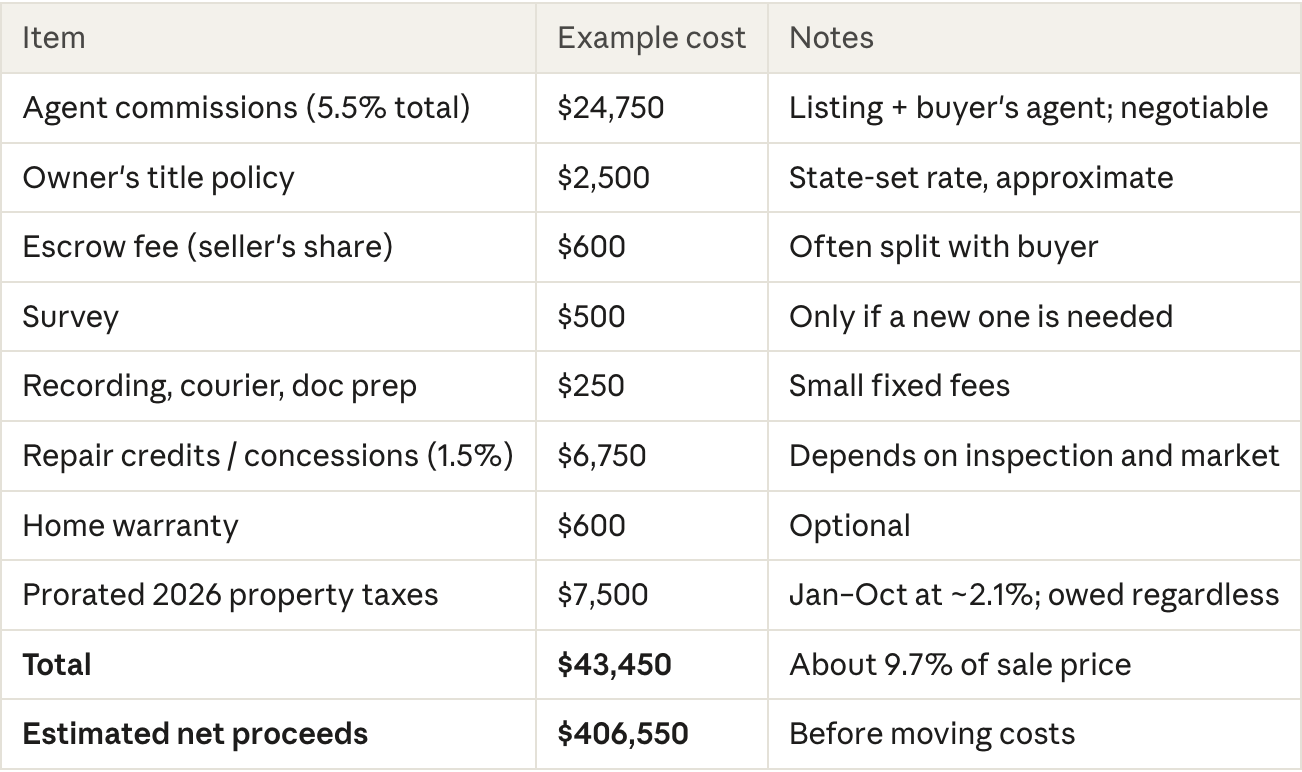
Your numbers will differ. Tax rates vary by city and school district, and a remaining mortgage balance comes off the top. Ask for a personalized net sheet before you list.
6. Will you owe taxes on the profit?
For most downsizers, no. Texas has no state income tax, and federal law lets you exclude up to $250,000 of gain ($500,000 for married couples) on a primary home you've owned and lived in for two of the last five years.
Long-time owners in fast-growing areas like Collin and Denton counties can exceed that, though. If you bought decades ago, gather records of major improvements — a new roof, an addition, a remodel — since they raise your cost basis. Talk with a CPA before you list, not after.
Know your number before you list
Selling the family home is a big decision, and the money question shouldn't be a guess. A clear net sheet tells you what you can spend on your next home, whether a single-story near family or a lock-and-leave condo, and what stays in savings.
If you're thinking about downsizing anywhere from Dallas–Fort Worth up to the Oklahoma border, reach out for a free, no-pressure net sheet on your home. We'll walk through every line together.
This article is general information, not legal, tax, or financial advice. Figures are estimates as of October 2026.
Sources
- Closing Costs for Sellers in Texas: 2026 Data — Real Estate Witch
- Real Estate Agent Commission — WealthVieu
- Who Pays Title Insurance Costs in Texas — JVM Lending
- Complete Guide to Title Insurance in Texas (2026) — Neuhaus Realty
- Texas Title Insurance Cost Calculator 2026 — Harbert Group
- Seller Closing Costs in Texas 2026 — Neuhaus Realty

Scott Wandell
| Homestead Realty Group | Scott Wandell | eXp Realty
or another way